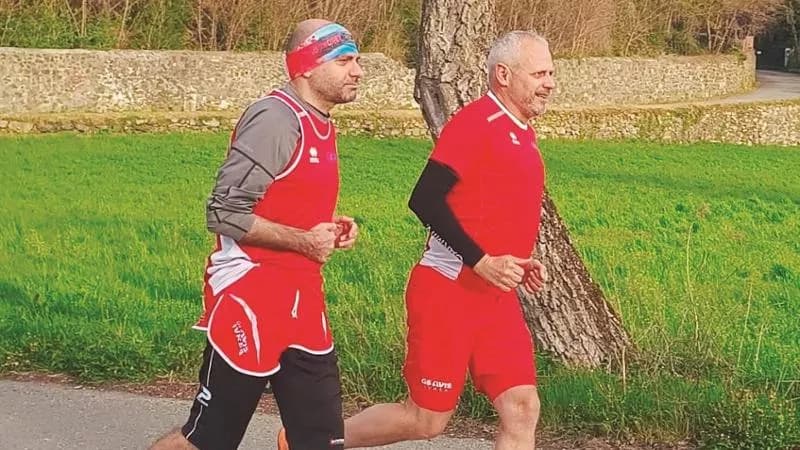
There’s a story running with us this year. It belongs to Damiano, 49, from Ivrea, an office worker and amateur runner. A story about courage, excellent medicine and what sport can do even when everything seems lost. A true story that deserves to be told.
A sharp pain during a run
It all began during an ordinary training run. Ten kilometres, his usual pace, steady breathing. Then, suddenly, a pain in his chest. Short and intense. Damiano stopped, and it passed. He told himself it was probably nothing.
But a few days later he was struggling to climb the stairs. He wanted to get to the bottom of it.
The diagnosis was devastating: fulminant giant cell myocarditis, a rare and deadly disease in which the heart can no longer support the body. No previous symptoms, no family history. Just a sharp pain, and then the abyss.
The Molinette, ECMO, the waiting list
Rushed to the Molinette hospital in Turin, Damiano went through the most critical moments of his life. First the Coronary Intensive Care Unit, coordinated by Dr Simone Frea of Professor Gaetano Maria De Ferrari’s University Cardiology department. Then the transfer to Cardiac Surgery Intensive Care, coordinated by Dr Anna Trompeo, where his condition deteriorated rapidly until he needed ECMO support: the extracorporeal circulation machine that was literally keeping him alive while the doctors raced against time. The situation was extreme: he was put on the national urgent transplant list.
Even at the most critical moments, connected to ECMO and bedridden, Damiano didn’t give up. He started moving, exercising his muscles, trying to sit up and stand. He fell, got back up, tried again.
He says sport taught him this: set yourself a goal, suffer to reach it, never give up. That mindset, at the darkest moment of his life, probably saved his life twice.
Eight days. Then, in the night, a heart.
After eight days on ECMO came the turning point: a compatible heart became available. The operation was performed by Professor Massimo Boffini together with Dr Erika Simonato. His condition was extremely critical, but it’s precisely in cases like this that a transplant is the only real chance of survival. It went well. It gave Damiano a new chance at life.
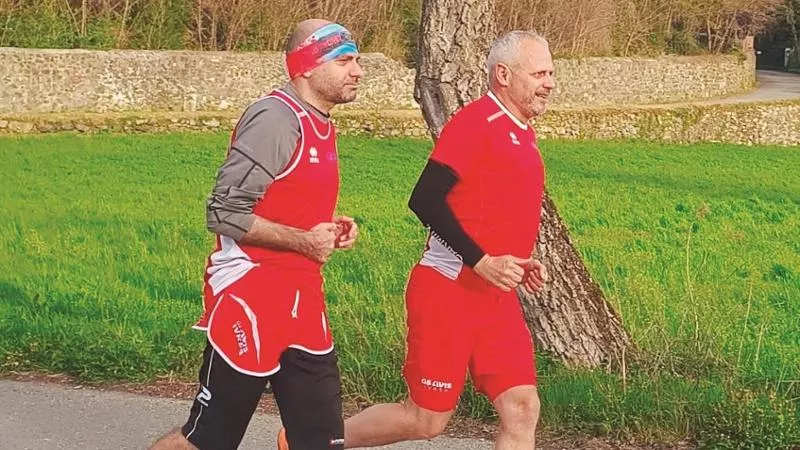
After the transplant came a long rehabilitation at the IRCCS Fondazione Maugeri in Veruno, under the supervision of Dr Massimo Pistono. Then the first steps. Then work. Then the first kilometres of running, more and more of them, and training sessions with some of the doctors from Professor Mauro Rinaldi’s team, especially Dr Matteo Giunta.
A milestone that goes beyond Damiano
Damiano’s story is intertwined with an extraordinary milestone for medicine in Piedmont: the Heart and Lung Transplant Centre at the Molinette hospital, directed by Professor Mauro Rinaldi, is now celebrating 1,300 transplants since it began: 800 hearts and 500 lungs, from 1990 to today. A number that tells of decades of brave decisions, advanced technology and lives given back.
Also contributing to this result is the partnership between the Fondazione DOT – Donazione Organi Trapianti, a non-profit founded by the Città della Salute, the City of Turin, the Piedmont Region, the University and the Politecnico, and Reale Foundation, in the three-year project ITT – InnovaTrapianto a Torino, which aims to strengthen excellence in transplant medicine by introducing advanced technologies. In 2025 the project has already brought new diagnostic tools and advanced organ transport systems.
Fondazione DOT works every day to promote a culture of donation and support scientific research in this field. Because behind every transplant there’s a choice: that of someone who decided to donate.
19 April: closing the circle
On 19 April Damiano will be on the start line of LA MEZZA DI TORINO. Exactly one year after his transplant.
And he won’t be alone: running with him will be the Molinette doctors who saved him, including Dr Matteo Giunta, who trained alongside him on his way back.
The date is no coincidence: 19 April 2026 is Italy’s National Day for Organ and Tissue Donation and Transplantation, established by ministerial decree and published in the Official Gazette. A day that this year, thanks to Damiano, will have a face, a steady stride on the streets of Turin and a number on a chest.
Damiano isn’t chasing a time. His goal is to be there.
“For me, running again and taking part in this race means closing the circle that opened exactly a year ago.”
Why this story matters to us
At Base Running we organise races. We think about courses, logistics, start times and aid stations. But stories like Damiano’s remind us why all of this really matters.
A race is a place where people feel alive again. Where circles close. Where a man with a new heart can start again exactly where he left off: on the road, shoes on, his breathing settling back into rhythm.
As Livio Tranchida, director general of the Città della Salute, said, Damiano’s story shows that it’s possible to return to a normal life after a transplant, thanks in part to sport, and confirms the value of physical activity as therapy too.
We already knew it. But it’s always good to hear it said like that.
See you on 19 April.